Every road sign and pavement marking looks fine in daylight. The real test comes after dark, and that is where the three main grades of retroreflective sheeting — Engineering Grade, High Intensity Prismatic, and Diamond Grade, stop being interchangeable. Choosing the wrong one does not just affect how a sign looks; it affects how far away a driver can read it, how many years it will last before it needs replacing, and whether it will pass a government inspection at all.
This guide breaks down the three grades side by side — what they are made of, how bright and how durable they are, what they cost, and which one actually fits your project. If you already understand why retroreflective sheeting matters for road safety, this article picks up where that conversation leaves off; if you want the background first, see our guide on how reflective sheets improve road visibility and reduce accidents before diving into the grade comparison below.
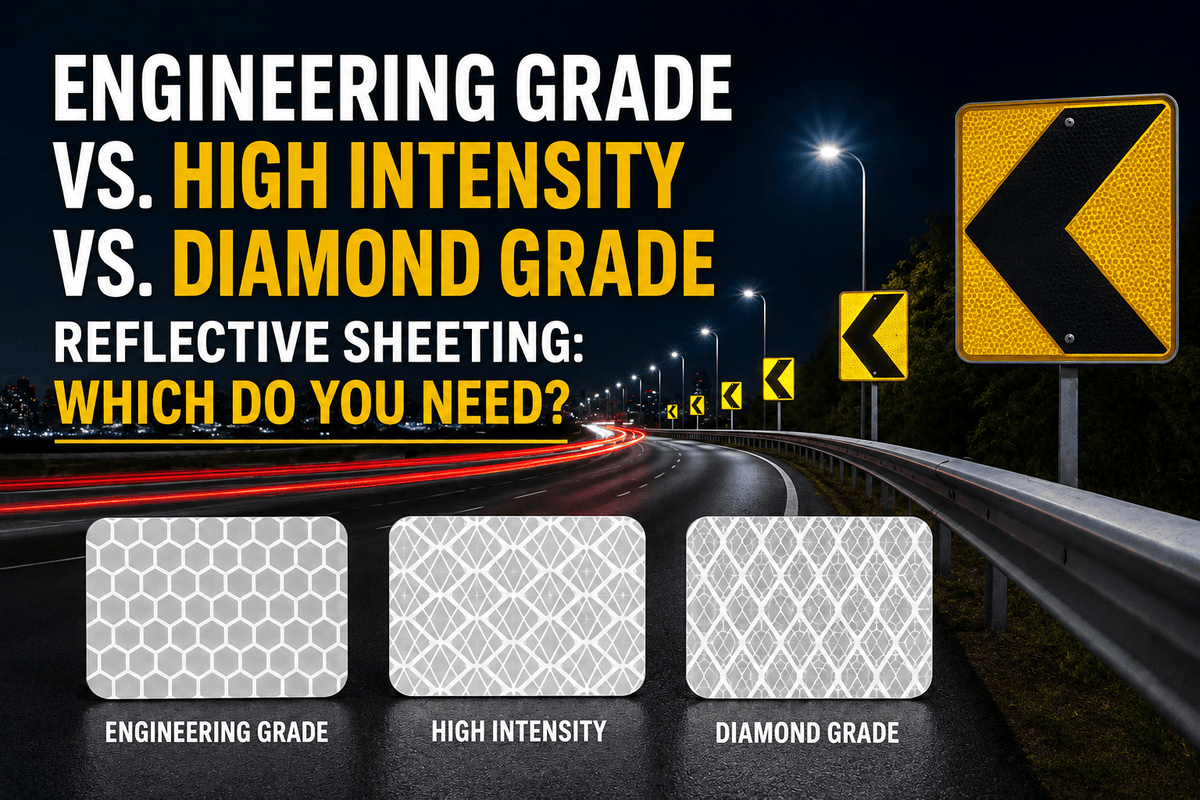
Retroreflective sheeting is classified by how it is built and how much light it sends back to a driver’s eyes. Under international standards such as ASTM D4956 (and the equivalent EN 12899 framework used across many government specs), sheeting is grouped into types based on the reflective technology inside the film:
The grade you choose determines the retroreflectivity coefficient (RA) of the finished sign — essentially, how bright it appears in a driver’s headlights from a given distance. Road authorities set minimum RA values for different sign types and road classes, and a sign that falls below that threshold has to be replaced regardless of how it looks in daylight.
Engineering Grade is the entry-level sheeting in the retroreflective family. It uses enclosed glass beads to return light to the driver, which gives reliable but modest brightness compared to prismatic alternatives.
Engineering Grade is the lowest-cost option per sheet, which makes it attractive for budget-sensitive jobs. It is a reasonable fit for low-speed streets, parking facilities, temporary signage, and secondary roads where reaction distance is less critical. It is generally not appropriate as the primary sheeting on highways, motorways, or any road where vehicles travel above roughly 60–80 km/h, because the shorter visibility distance does not give drivers enough time to react.
High Intensity Prismatic sheeting sits in the middle tier. It replaces glass beads with microprismatic cube-corner optics, which redirect light far more efficiently and produce a noticeably brighter, sharper return than Engineering Grade.
HIP sheeting costs more than Engineering Grade but noticeably less than Diamond Grade, and it is often the most cost-efficient choice for arterial roads, urban and suburban corridors, and moderate-speed environments where higher visibility is needed but motorway-level performance is not required. Many government contracts specify HIP as the minimum acceptable grade for primary signage on collector and arterial roads.
Diamond Grade is the top-tier microprismatic sheeting available, using a full-cube prismatic structure engineered for maximum light return. It is the sheeting most road authorities specify for the highest-risk, highest-speed environments.
Diamond Grade carries the highest upfront material cost, but it also holds compliance the longest and gives drivers the most reaction time — both of which matter directly for safety outcomes. It is the correct specification for motorways, national highways, school zones, work zones, curves, and any location where speed leaves little margin for a late reaction. Most national highway authority specs mandate Diamond Grade (or equivalent Type IX/XI sheeting) on primary route signage for exactly this reason.
Engineering Grade | High Intensity Prismatic | Diamond Grade | |
|---|---|---|---|
Reflective technology | Enclosed glass beads | Microprismatic (HIP) | Full-cube microprismatic |
Typical daytime/night visibility distance | ~500 ft | ~800–1,000 ft | 1,500–1,600+ ft |
Relative brightness (RA) | Baseline | 3–5x Engineering Grade | Up to 60% of incoming light returned |
Typical service life | 7–10 years | 10–12 years | 10–15+ years |
Relative material cost | Lowest | Mid-range | Highest |
Best suited to | Low-speed roads, secondary/temporary signage, parking areas | Arterial roads, moderate-speed corridors, urban signage | Motorways, highways, school zones, work zones, high-speed roads |
Typical spec use | Private/commercial, budget-driven jobs | Mixed government and private contracts | Government highway contracts, NHA/motorway specs |
In Pakistan, the grade requirement often comes down to who is awarding the contract and what road class the signage sits on:
National and provincial highway authority tenders typically write minimum sheeting grades directly into the bill of quantities, and for motorways, national highways, and school zones the spec almost always calls for Diamond Grade (or its ASTM Type IX/XI equivalent). Submitting Engineering Grade or unspecified HIP material against a Diamond Grade line item is a common cause of rejected shipments and delayed payments on government projects, so it is worth confirming the exact grade called out in the tender document before ordering, not after installation.
Private developments, commercial plazas, housing societies, and internal facility signage generally have more flexibility. Here the decision is more of a genuine trade-off between upfront budget and total lifecycle cost. A private client with a tight budget and low-speed internal roads can reasonably specify Engineering Grade or HIP; a private client managing a large campus with public through-traffic may still want HIP or Diamond Grade for liability reasons, even without a regulatory mandate.
Work through these four factors before specifying a grade:
When speed, regulation, or long-term liability is involved, the higher grade is almost always the more economical choice once replacement cycles and accident risk are factored in — not just the safer one.
Reliable Road Safety supplies Engineering Grade, High Intensity Prismatic, and Diamond Grade reflective sheeting as the official DM China distributor in Pakistan. Browse our reflective sheeting range in the Shop or contact our team to confirm the correct grade for your government or private contract spec.
The main difference is the reflective technology and resulting brightness. Engineering Grade uses glass beads and is visible from about 500 feet, while Diamond Grade uses full-cube microprismatic optics and is visible from up to 1,500–1,600 feet, giving drivers significantly more reaction time.
HIP sheeting performs well on arterial and moderate-speed roads, but most highway authority specs require Diamond Grade or an equivalent high-performance sheeting for motorways and national highways, where maximum reaction distance is critical.
Most national and provincial highway tenders specify Diamond Grade (or ASTM Type IX/XI equivalent) for primary route signage, motorways, and school zones. Always confirm the exact grade in the bill of quantities before ordering, since specs vary by project and road class.
Not automatically, but often yes for high-speed or high-liability roads. Diamond Grade costs more per sheet but lasts longer and maintains compliance longer, which usually lowers the total cost per year of service compared to more frequent replacement of lower-grade material.
Yes. It is common to specify Diamond Grade for main route and high-speed signage while using Engineering Grade or HIP for secondary, low-speed, or temporary signage on the same project, as long as each application meets its applicable minimum RA requirement.
Sheeting grade is not always visible to the eye once installed. Checking the original purchase specification, supplier documentation, or having RA values tested with a retroreflectometer is the reliable way to confirm what grade is currently in use.
Whichever grade your project needs, Reliable Road Safety stocks certified reflective sheeting for government and private contracts across Pakistan. Visit the Shop to view available grades, or read more on how reflective sheeting improves road safety.