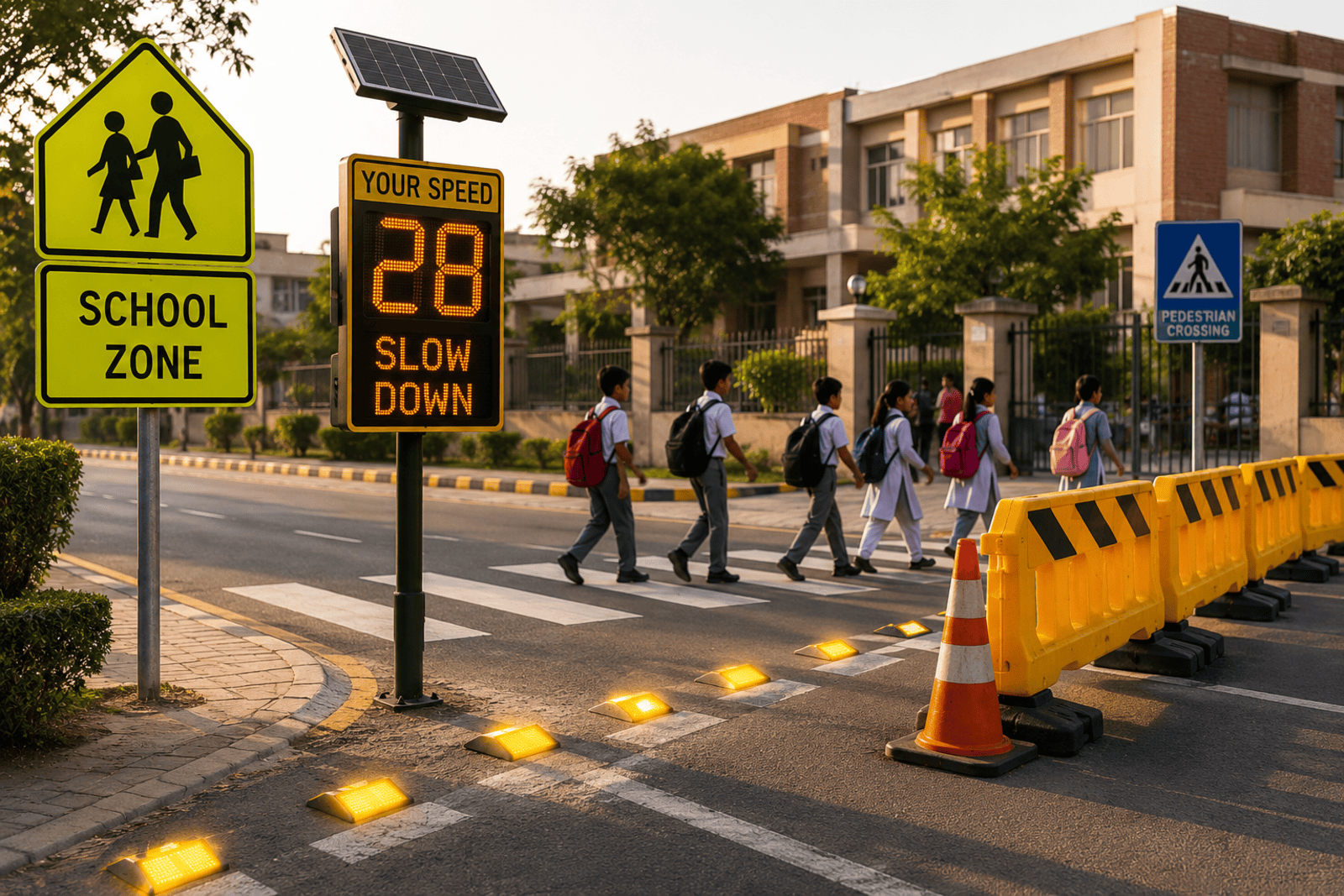
Every school zone carries the same risk twice a day. Children cross roads, cars slow down or speed through, and a single second of poor visibility can turn into a tragedy. Choosing the right school zone safety equipment guide decisions on visibility, speed control, and clear signage, all of which reduce that risk in practical, measurable ways.
Contractors, school administrators, and local government officials all face the same question when planning a crossing: which products actually make a difference, and which ones are just nice to have.
The categories below cover what matters most, along with practical pointers for matching equipment to your specific road layout.
Children behave unpredictably near roads. They dart into crossings, misjudge vehicle speed, and often lack the visibility awareness adults rely on when navigating traffic.
Pakistan’s road safety numbers reflect this risk clearly. Pedestrians account for 41% of all road traffic fatalities in the country, well above the Asia-Pacific average of 31% for pedestrians and cyclists combined. A pilot study of schools in Karachi found that only one out of 94 surveyed schools had a proper zebra crossing, and most lacked designated pickup and drop-off parking areas entirely.
These gaps make dedicated school zone equipment less of an upgrade and more of a basic necessity. Proper signage, visibility tools, and speed control devices directly address the exact conditions researchers have flagged as high-risk.
A complete school zone setup usually draws from a handful of core equipment categories. Each serves a different function, and most effective zones combine several at once.
Warning signs only work if drivers can see them, day or night. Diamond grade and engineer grade reflective sheeting give school zone signs the visibility needed during early morning drop-offs, evening pickups, and low-light conditions.
Signs made with high-quality reflective material, like DM8900 diamond grade sheeting, stay legible from a much greater distance than standard painted signs. This extra reaction time matters most in the seconds before a driver reaches a crossing.
Posted speed limits alone rarely change driver behavior. Real-time driver feedback signs display a vehicle’s actual speed as it approaches, which studies consistently show has a stronger effect on slowing traffic than static signage.
A solar-powered driver feedback sign with a large, clear display works especially well outside schools, where drivers need an immediate, visible prompt to reduce speed before reaching a crossing area.
Lane markings fade fast under Pakistan’s heat and monsoon rains. Road studs, sometimes called cat eyes, give drivers a permanent, reflective reference point for lane position and crossing zones, even after paint wears away.
Solar road studs add an extra visibility boost after dark, lighting up crossing points and lane edges without needing external power. For a closer look at how these work, our complete guide to road studs covers types, colors, and installation basics.
Not every school zone hazard is permanent. Pickup and drop-off times often need temporary traffic control, especially where parking spills onto the road or where construction nearby adds extra congestion.
High-visibility traffic cones work well for short-term lane closures and temporary pedestrian channeling during peak hours. For a breakdown of when cones make more sense than heavier equipment, see our comparison on traffic cones versus traffic barrels.
Some school zones need something sturdier than cones, particularly at high-traffic entrances or alongside construction near a campus. Interlocking safety barriers create a physical boundary between vehicles and pedestrian areas, offering protection that lightweight devices cannot match.
The ETEP SafeFence system is built for exactly this kind of application, forming a heavy-duty barrier line that holds up under repeated impact and daily wear.
Not all safety products are built to the same standard, and school zones deserve equipment that performs consistently.
Products should meet recognized international safety standards, not just local manufacturing norms. Reflective sheeting, in particular, varies widely in reflectivity and lifespan depending on grade, so checking certification details before purchasing saves headaches later.
Karachi’s heat, Lahore’s monsoon season, and general wear from daily traffic all shorten the lifespan of poorly made equipment. Choosing UV-stable materials and weatherproof housings for solar-powered signs pays off over the full life of the product.
School zones often lack easy access to electrical wiring, especially at temporary or semi-permanent crossings. Solar-powered driver feedback signs and road studs remove the need for wiring altogether, simplifying installation and reducing long-term maintenance costs.
Larger school districts or municipal projects need consistent stock across multiple zones. Working with a supplier that keeps bulk inventory on hand, rather than ordering per-project from overseas, cuts down on delays that can leave a crossing unprotected for weeks. Reliable Road Safety maintains ready stock in Karachi specifically to avoid this kind of gap.
Buying the right equipment works best as part of a coordinated plan rather than a scattered purchase list.
Start with visibility first. Reflective signage and road studs form the baseline that every other measure builds on, since drivers need to see a school zone before they can react to it.
Add speed control next. Driver feedback signs target the specific behavior, speeding through the zone, that causes the most severe accidents.
Finish with physical protection. Safety barriers and temporary cones handle situations where visibility and speed control alone are not enough, particularly during high-traffic pickup and drop-off windows.
For a broader look at matching equipment to a specific project’s needs, our guide on how to choose the right road safety equipment covers additional selection criteria beyond school zones specifically.
A well-equipped school zone combines visibility, speed control, and physical protection into one coordinated system. Reflective signage catches a driver’s attention early, feedback signs slow them down, and barriers or road studs handle the rest.
Planning a school zone safety project and need certified, ready-to-ship equipment? Get a bulk quote from Reliable Road Safety and equip your project with products built for Pakistan’s roads.
Most zones benefit from at least one sign placed before the main approach to the crossing, with a second sign useful for zones with traffic entering from multiple directions.
Quality solar road studs are built to withstand years of vehicle traffic, though replacement frequency depends on traffic volume and installation quality.
Diamond grade sheeting reflects light from a wider angle and greater distance, making it the stronger choice for school zone signs where early visibility matters most.
Cones work well for short, supervised windows like pickup and drop-off, while barriers suit zones needing constant separation between traffic and pedestrians throughout the school day.
Signage and cones are generally straightforward to install, though driver feedback signs and permanent road studs often benefit from guidance to ensure correct placement and power setup.
Speak with our Karachi-based team about your project’s requirements.