Every road and construction project depends on one deceptively simple decision: which barricades to put between people and hazards. Get it right, and traffic flows safely around your work zone, pedestrians stay clear of open trenches, and your crew works without constant near-misses. Get it wrong, and you’re looking at accidents, non-compliance flags from inspectors, and barricades that blow over in the first strong wind or crack under repeated vehicle contact.
With options ranging from lightweight delineator posts to heavy interlocking plastic barriers, choosing the right barricade isn’t just about grabbing whatever’s in stock. It comes down to matching the product to your traffic conditions, project timeline, and site environment. This guide walks through the main barricade types used on Pakistani roads and construction sites, and the factors that should drive your decision.
Barricades do more than mark a boundary — they’re a physical and visual signal that tells drivers and pedestrians to slow down, divert, or stay back. When the wrong barricade is used for the situation, say, a lightweight cone on a highway shoulder, or a static barrier without reflective strips on a night shift, the result is reduced visibility, weaker containment, and a higher risk of collision.
There’s also a compliance angle. Government contracts and NHA-regulated projects typically specify minimum standards for work zone protection, and using under-spec barricades can mean failed inspections, rework, or liability if an incident occurs. Choosing correctly the first time saves money, protects your crew, and keeps your project on schedule.
Reliable Safety Solutions keeps bulk stock ready for immediate dispatch across Pakistan.
Not all barricades serve the same purpose. Here’s a breakdown of the main categories you’ll come across when planning a project.
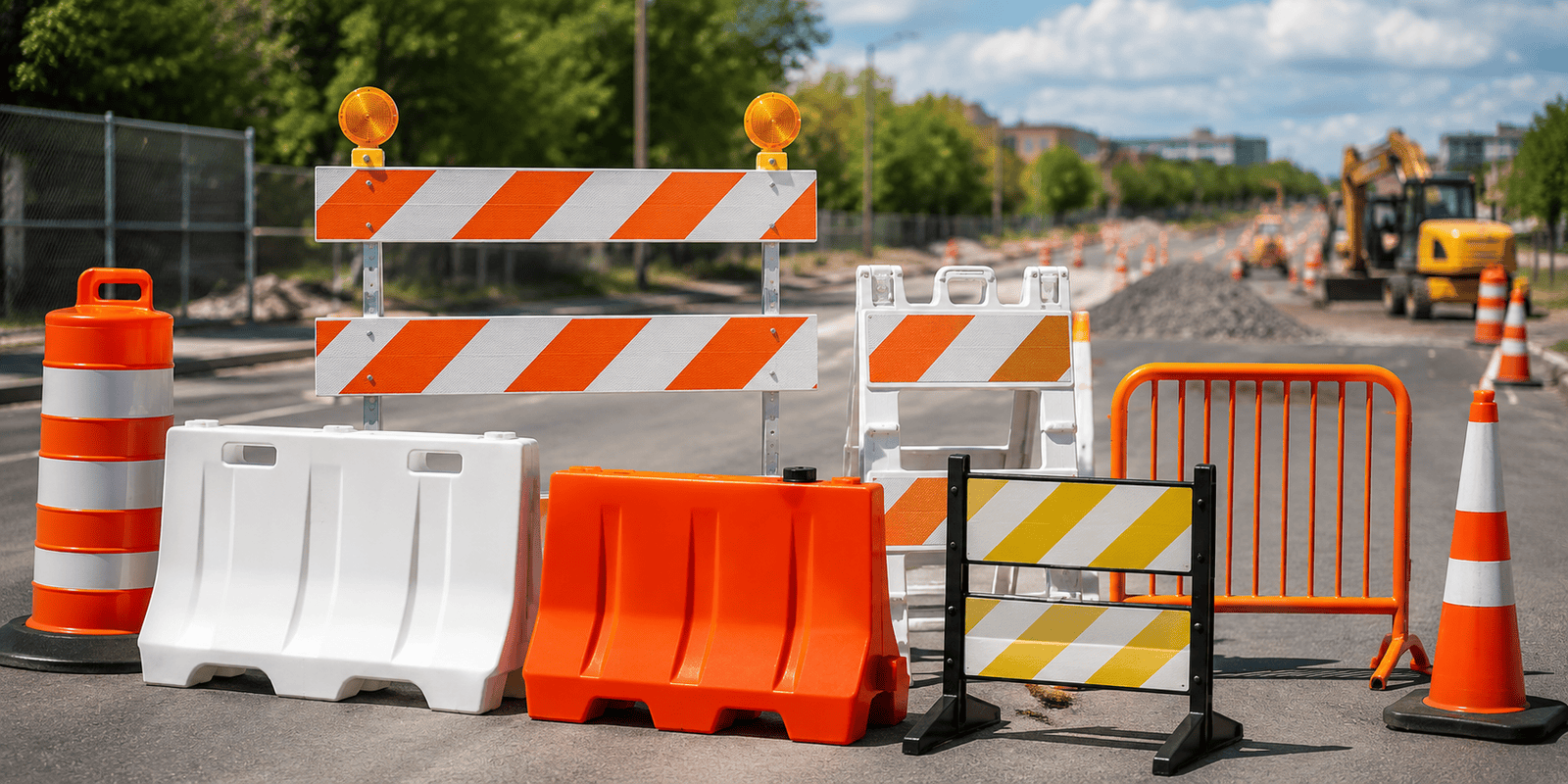
Products like the ETEP SafeLine and ETEP SafeWall are heavy-duty, interlocking plastic barriers designed to form a continuous wall along a work zone. They connect end-to-end, so you can build a barrier line of any length without gaps for pedestrians or vehicles to slip through. These are the go-to choice for construction sites, lane closures, and any zone where you need a solid, visible line of separation that can be extended or reconfigured as work progresses.
Barriers such as the ETEP SafePath can be filled with water or sand for added weight and stability, making them ideal for locations exposed to wind, vehicle contact, or higher-speed traffic. Empty, they’re lightweight and easy to transport; filled, they hold their position reliably — a practical combination for projects that need to move barriers between phases or sites.
For projects that need a taller, more continuous physical barrier, think excavation sites, elevated work areas, or zones with pedestrian foot traffic nearby, modular fencing systems like the ETEP SafeFence provide a higher visual and physical deterrent than low-profile barriers alone.
Delineator posts mark lane shifts, tapers, and boundaries without the bulk of a full barrier. They’re commonly used alongside barriers to guide traffic gradually into a new lane pattern, particularly on highways and motorways where drivers need early, clear warning of a change ahead. See our ETEP delineator post range for available heights.
For short-duration work, quick lane shifts, or low-speed zones, traffic cones remain the fastest way to establish a temporary boundary. They’re not a substitute for barriers on longer or higher-risk projects, but they’re indispensable for flagging hazards, marking parking restrictions, or supplementing a barrier line at entry and exit points. Read more on why durable traffic cones matter on highways and construction sites.
A one-day utility repair has very different needs than a six-month highway widening project. Short jobs can often get by with cones and lightweight delineators, while long-term sites need barriers rated for extended outdoor exposure and repeated impact.
Higher-speed roads demand heavier, more stable barriers, water-filled or interlocking systems, placed further back from the live lane, along with a longer taper of delineator posts to warn drivers early. Low-speed urban streets and parking areas can generally use lighter barricades.
Barricades used near live traffic, especially at night, need reflective sheeting or strips to remain visible to drivers. This matters just as much as the barrier itself: a barricade a driver can’t see at 100 meters isn’t doing its job.
Crews that reposition barriers frequently, for phased construction or shifting lane closures, benefit from lightweight, interlocking designs that don’t require heavy equipment to move. Sites with a fixed footprint for the whole project duration can prioritize maximum stability over portability.
Wind-prone areas, uneven ground, or heavy monsoon rain all affect which barricade design will actually stay in place. Water- or sand-fillable barriers are often the more reliable choice in exposed or unstable conditions.
Government and NHA-regulated projects typically require barricades that meet recognized safety and visibility standards. Confirming this upfront avoids the cost of replacing non-compliant equipment mid-project.
Barricade costs add up quickly on larger projects. Sourcing directly from a distributor with bulk stock and wholesale pricing, rather than through multiple smaller vendors, usually works out significantly more cost-effective.
Browse our full range of interlocking barriers, fencing, delineators, and cones.
High-speed roads call for the heaviest protection: interlocking or water-filled barriers combined with delineator posts to create a clear, gradual taper, plus reflective sheeting rated for high visibility at distance and speed.
City streets and areas with foot traffic need barriers that are visible at close range and physically block pedestrian access to hazards. Modular fencing and interlocking barriers both work well here, often paired with cones at access points.
Multi-month or multi-year projects justify investing in heavier-duty, weather-resistant barriers rather than repeatedly replacing lighter equipment. The upfront cost is typically offset by reduced replacement and maintenance over the life of the project.
Even the right barricade won’t perform well if it’s neglected.
As the official DM China distributor in Pakistan, Reliable Safety Solutions supplies interlocking barriers, fillable barriers, safety fencing, delineator posts, and traffic cones that meet international safety standards. We maintain bulk stock in Karachi for fast, nationwide delivery, so contractors and government projects aren’t left waiting on backordered equipment. Browse our full shop or talk to our team, who can help match barricade types to your specific project conditions, with competitive wholesale pricing on bulk orders. For a broader look at outfitting a work zone, see our guide on how to choose the right road safety equipment for your project.
Request a bulk quote from our Karachi-based team today.
Traffic cones are lightweight markers best suited to short-term, low-speed situations like quick lane shifts or flagging a hazard. Barricades, interlocking barriers, fillable barriers, or fencing, provide a more solid, continuous physical boundary and are built for longer-duration or higher-speed work zones.
This depends on the length of the work zone, the taper distance required for the traffic speed, and local regulatory requirements. Our team can help calculate the right quantity based on your site layout.
Yes, when they’re purpose-built for the application. Interlocking and water-filled barriers like the ETEP SafeLine and ETEP SafePath are engineered to withstand vehicle contact and hold their position under highway conditions, provided they’re filled and positioned correctly.
For any barricade used near live traffic, especially during low-light or nighttime hours, reflective sheeting is essential. It’s often a compliance requirement on government and NHA-regulated projects.
Yes. Reliable Safety Solutions maintains bulk inventory in Karachi with fast dispatch across Pakistan, so you’re not stuck waiting on backordered stock. Contact us for a free quote.
Speak with our Karachi-based team about your project’s requirements.