When it comes to setting up a safe and compliant work zone, every product decision matters. Two of the most commonly used channelizing devices on roads, highways, and construction sites are traffic cones and traffic barrels (also called drum delineators). While both serve the core purpose of guiding drivers and protecting workers, they are not interchangeable. Choosing the wrong one for your project can reduce visibility, create compliance issues, and put lives at risk.
In this guide, we break down the key differences between traffic cones and traffic barrels, the scenarios where each excels, and how to select the right channelizing device for your work zone. Whether you’re managing a highway project, an urban road repair, or a temporary traffic diversion, this comparison will help you make the safest and most cost-effective choice.
At Reliable Safety Solution, Pakistan’s trusted supplier of certified road safety products, we carry a full range of traffic safety equipment designed to meet international standards and local project requirements.
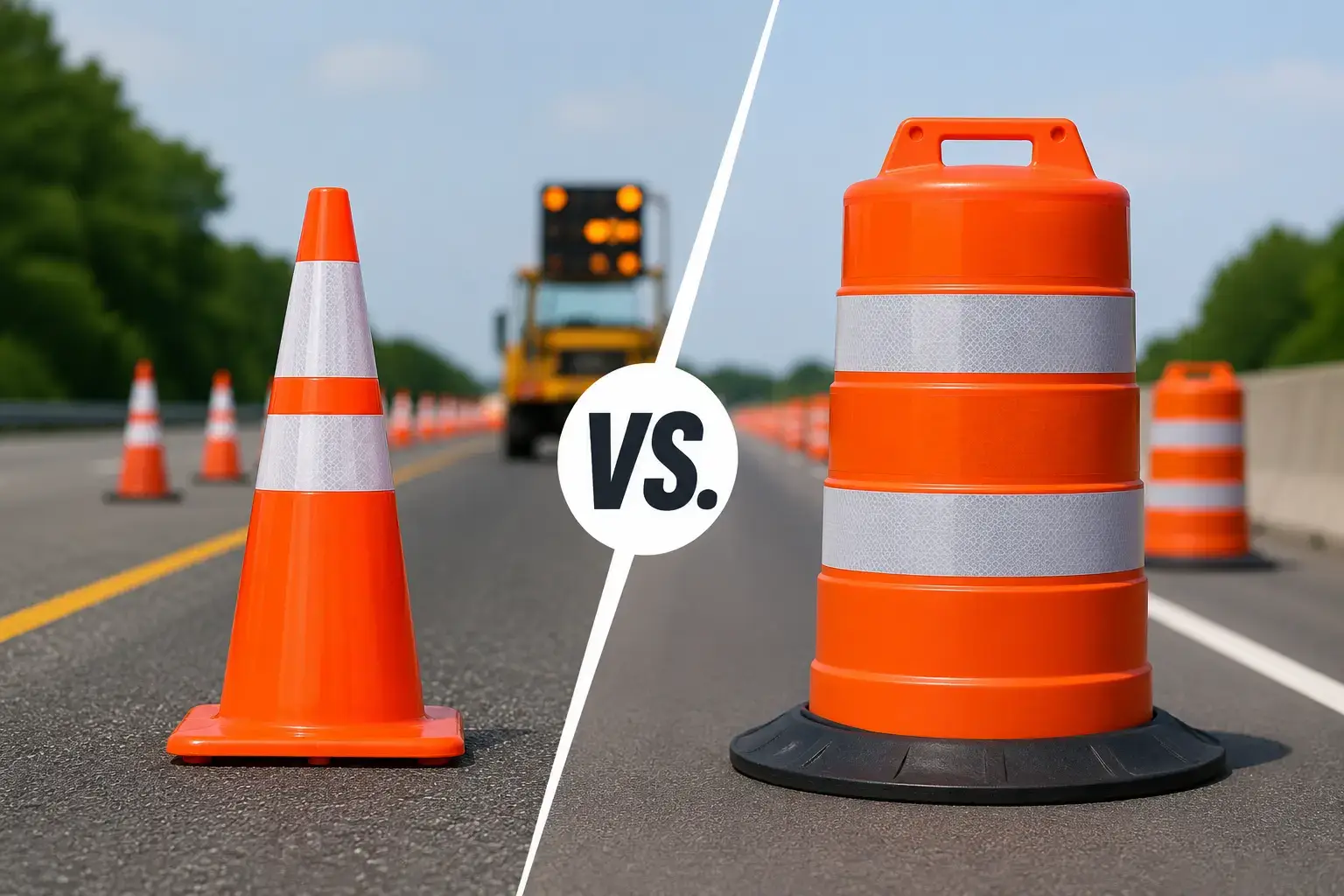
A traffic cone, commonly known as a safety cone, road cone, or pylons — is a conical-shaped marker typically made from PVC (polyvinyl chloride) or rubber. They are bright orange with one or more white retroreflective bands, making them highly visible during the day and at night under headlights.
Traffic cones are among the most versatile and widely-used road safety devices globally. At Reliable Safety Solution, our high-visibility traffic cones are manufactured from durable orange PVC and are suitable for highways, work zones, and parking areas across Pakistan.
A traffic barrel — also called a drum delineator, channelizing drum, or road barrel — is a larger, cylindrical device used for high-impact work zone delineation. Traffic barrels are taller, wider, and more visible than cones, making them the preferred choice for high-speed roads and major highway projects.
Traffic barrels offer significantly greater visibility than standard cones — especially critical on high-speed roadways where drivers have less reaction time. Their larger reflective surface area makes them visible at greater distances, which is a key safety advantage at night or in low-visibility conditions.
Feature | Traffic Cone | Traffic Barrel |
Height | 28–36 inches | 36–48 inches |
Visibility Range | Moderate | High (larger reflective area) |
Best Use | Low-to-medium speed zones | High-speed highways |
Portability | Highly portable / stackable | Moderate (nest or fold) |
Wind Resistance | Lower (lighter) | Higher (weighted base) |
Cost | Lower | Moderate to higher |
Impact Recovery | Spring back after impact | Tip and deform; designed for impact |
Indoor / Parking Use | Yes | Less common |
Note: For projects requiring barriers rather than delineation, consider our ETEP SafeLine plastic safety barriers or ETEP SafeFence systems for complete traffic management and construction zone separation.
Traffic cones are the go-to solution for short-term, lower-speed work zones where portability and quick deployment are priorities. Here are the most common use cases:
In city environments where traffic speeds are lower (typically under 45 km/h), traffic cones provide fast, flexible delineation. They’re easy to reposition as work progresses and stack neatly for transport between job sites.
Traffic cones are ideal for controlling vehicle flow in parking areas, designating no-parking zones, and guiding pedestrians — without the need for heavy, permanent infrastructure.
Temporary road diversions, event venues, and crowd management situations call for equipment that can be set up and removed quickly. Cones excel in these scenarios due to their light weight and ease of handling.
Smaller traffic cones are routinely used inside warehouses, factories, and facilities to mark hazardous areas, wet floors, and restricted zones — environments where barrels would be impractical.
For short-term highway work (under 1 hour) in lower-speed environments, cones arranged in a taper pattern with proper spacing can be effective. However, for sustained highway projects at speeds above 80 km/h, traffic barrels or delineator posts are a safer choice.
Traffic barrels are engineered for high-stakes, high-speed work zone environments. Their superior visibility and impact characteristics make them the standard for major highway and infrastructure projects.
On high-speed roads where vehicles travel at 80 km/h or more, traffic barrels offer the increased conspicuity and physical presence needed to give drivers adequate warning. Their larger profile is visible at greater distances — critical when reaction times are short.
When a project spans multiple days, weeks, or months, traffic barrels provide more durable, stable delineation. Their weighted bases resist wind, vehicle turbulence from passing trucks, and accidental bumps better than cones.
The wider retroreflective striping on traffic barrels reflects headlights across a larger surface area, making them significantly more visible at night than standard traffic cones. For any night-time highway work, barrels are strongly recommended.
When closing one or more lanes on an active highway, the taper zone demands equipment that drivers can clearly see and respect. Traffic barrels — especially when combined with advance warning signage — provide the high-visibility channelization required.
Confined spaces with high vehicle speeds require maximum conspicuity. Traffic barrels are the preferred device in these environments because their size and reflectivity leave no ambiguity about lane restrictions.
Not every project falls cleanly into one category. Use these criteria to guide your decision:
This is the single most important factor. For roads with posted speeds above 70–80 km/h, traffic barrels are almost always the preferred choice due to their greater visibility. For lower-speed urban or temporary zones, cones may be sufficient.
Short-term setups (under 24 hours) are often well-served by cones. Long-term projects benefit from the durability and stability of traffic barrels.
High-wind areas, monsoon conditions, or sites with heavy truck traffic require weighted barrels. Lightweight cones can be knocked over easily, creating safety hazards. In Pakistan, seasonal weather conditions along major highways make this a particularly important consideration.
Traffic cones typically have a lower unit cost, making them cost-effective for projects requiring large quantities. Traffic barrels cost more per unit but provide better ROI on long-duration, high-risk work zones where the cost of an incident far outweighs equipment expenses. Contact our team at Reliable Safety Solution for bulk pricing on both products.
Always check applicable road authority guidelines (NHA, Provincial Highway Authorities) before specifying your work zone devices. Certain project categories mandate specific equipment types and spacing requirements.
Absolutely — and in many cases, a combination approach is best practice. A typical long-duration highway work zone might use:
Layering different device types according to their strengths is a smart, standards-compliant approach. Browse our complete traffic safety products catalog to find the right combination for your project.
Whether you choose traffic cones or traffic barrels, proper maintenance extends product life and keeps your work zone compliant:
As Pakistan’s leading road safety products supplier and the official DM China distributor in Pakistan, Reliable Safety Solution offers:
Whether you need traffic cones, barrels, barriers, or a complete work zone equipment package, our team is ready to help. Contact us today or browse our full product range to get started.
Traffic cones are best for low-to-medium speed zones, short-duration projects, and situations requiring portability.
Traffic barrels are best for high-speed highways, long-duration work zones, night-time operations, and projects where maximum visibility is non-negotiable.
When in doubt, prioritize safety over cost. Upgrading from cones to barrels on a high-speed project is a minor budget item compared to the human and financial cost of an avoidable incident.
Need help deciding? Visit our Traffic Safety Products page or read more road safety guides on our blog to make informed, safety-first decisions for every project.